Recently a certain country has mandated their government agencies to give preference to local software. To me, that's the biggest mistake you can ever make in policy-making.
Why? Reason is very simple. If your local developers do produce quality software, they will not worry about not finding deals. People will want to look for you because they know that you can be "trusted" to provide a solution.
The problem comes when you do not have the expertise in providing that solution. This is where the big players come in. Most of them will partner with locals as it will be easier for them to allocate their resources. In return, they sometimes share with them their expertise and knowledge. This is the way local developers can grow.
By giving preference to local developers, you're sending the message to these big guys that you do not welcome them. So why would they help your local developers to improve? There's nothing in it for them. Your local developers will also not be able to grow as fast in terms of their professional expertise because there is no "mentor" to guide them.
It'll be interesting to see that country's IT expertise 5 years down the road. Only the very best will be able to survive. Those people that want to join the industry will drop out one by one as there is no mentor to guide them. IT literacy may drop as a result and there will be shortage of skilled IT developers.
Worth it? Looks like another short-term view of looking at things.
Wednesday, November 25, 2009

Cloud Computing does not cut down duplication of resources. Virutalisation does!
Topic(s):
Technology Ramblings
Someone wrote an article saying that cloud computing cuts down total cost of ownership because of savings in duplication of resources needed for each application (e.g. servers). That to me is not the true advantage of cloud computing.
Reason is very simple. You can achieve the same savings just by going for the virtualisation route. Once you have virtualised your servers, it's quite simple to manage your resources on demand. Virtualisation may be quite painful to implement at the start but once implemented, you will be able to make better use of your server resources, especially for those instances where you buy 1 server just to run that special batch job from midnight to 4am in the morning. Allocation of resources can also be dynamic, moving resources from one application to another when the application needs it most.
So you want to cut down your TCO? Virtualisation is your answer.
Reason is very simple. You can achieve the same savings just by going for the virtualisation route. Once you have virtualised your servers, it's quite simple to manage your resources on demand. Virtualisation may be quite painful to implement at the start but once implemented, you will be able to make better use of your server resources, especially for those instances where you buy 1 server just to run that special batch job from midnight to 4am in the morning. Allocation of resources can also be dynamic, moving resources from one application to another when the application needs it most.
So you want to cut down your TCO? Virtualisation is your answer.
Monday, November 23, 2009
Inflation is down 0.8%
Topic(s):
Economic Ramblings,
Singapore Ramblings
These are the Singapore inflation rates for 2009:
January: 2.9%
February: 1.9%
March: 1.6%
April: -0.7%
May: -0.3%
June: -0.5%
July: -0.5%
August: -0.3%
September: -0.4%
October: -0.8%
Clothing and Footwear and Health Care has resumed leading the charge, rising by 2.7% and 2.2% respectively year on year. Housing costs once again decreased the most for the month (-4.7%) but will most probably increase soon due to the increase in property tax. As indicated previously, transport and communication inflation has also turned positive to 0.6%.
Sales seem to have slightly increase, based on what I could see in Orchard Road. However, I do not think this spike will push the inflation back to positive. I will still stick to my earlier post.
January: 2.9%
February: 1.9%
March: 1.6%
April: -0.7%
May: -0.3%
June: -0.5%
July: -0.5%
August: -0.3%
September: -0.4%
October: -0.8%
Clothing and Footwear and Health Care has resumed leading the charge, rising by 2.7% and 2.2% respectively year on year. Housing costs once again decreased the most for the month (-4.7%) but will most probably increase soon due to the increase in property tax. As indicated previously, transport and communication inflation has also turned positive to 0.6%.
Sales seem to have slightly increase, based on what I could see in Orchard Road. However, I do not think this spike will push the inflation back to positive. I will still stick to my earlier post.
No Good Service? That's because of a short term view
Topic(s):
Singapore Ramblings
The last time I had a good experience with service staff in Singapore was in a Turkish restaurant in Shaw Plaza. Even though there were 7 of us, each ordering different dishes, he remembered every dish that was called including the person who ordered it. There was no need for any prompting from any of us on who called what dish. The food was of course great.
End result? I will recommend this restaurant to more of my friends if they have a sudden craving for Turkish food or some food out of the ordinary. That's the dividends that good service will give if practiced sincerely and I do not mean those half-hearted greetings when you enter the shop, or the memorised script that some service staff read out as if they were sitting for an exam. Whether the staff means what they say, you can read it all just by the tone of the voice.
When you're looking at good service level in general, you have to think longer term. You might not get the results you want immediately and people may also take advantage of you. Bear in mind though that there are always a few rotten eggs in the basket. You should not think of the few bad eggs and instead think of the other good ones, one of which may be a hidden golden egg. If just because of those few bad eggs and you decided not make an effort to provide good service, you'll not be able to differentiate your business from the rest and you can get ready to shuttle down your doors soon as you will lack customer loyalty.
Good service also need not necessary mean that you have to lose money. A small gesture on the business owners' part can sometimes go a long way. After coming back from Japan, I miss the service that I've encountered there. Bear in mind that they do not even have service charge!
One very simple example. Going into a restaurant or even a small shop, water will be served to you the moment you sit down. Menu will be given and the highlights will be briefly mentioned. All these was done even though there's no service charge. Over here, some businesses even charge for plain water. Good grief.
This is the kind of good service that people will remember and this in a way encourages customer loyalty. People will want to go back to that shop because they enjoy being serviced by the staff. What consumers want to know is that the business is really concerned on what they want and not just to earn a quick buck.
Do not under-estimate word-of-mouth advertisement. It can make or break a business.
End result? I will recommend this restaurant to more of my friends if they have a sudden craving for Turkish food or some food out of the ordinary. That's the dividends that good service will give if practiced sincerely and I do not mean those half-hearted greetings when you enter the shop, or the memorised script that some service staff read out as if they were sitting for an exam. Whether the staff means what they say, you can read it all just by the tone of the voice.
When you're looking at good service level in general, you have to think longer term. You might not get the results you want immediately and people may also take advantage of you. Bear in mind though that there are always a few rotten eggs in the basket. You should not think of the few bad eggs and instead think of the other good ones, one of which may be a hidden golden egg. If just because of those few bad eggs and you decided not make an effort to provide good service, you'll not be able to differentiate your business from the rest and you can get ready to shuttle down your doors soon as you will lack customer loyalty.
Good service also need not necessary mean that you have to lose money. A small gesture on the business owners' part can sometimes go a long way. After coming back from Japan, I miss the service that I've encountered there. Bear in mind that they do not even have service charge!
One very simple example. Going into a restaurant or even a small shop, water will be served to you the moment you sit down. Menu will be given and the highlights will be briefly mentioned. All these was done even though there's no service charge. Over here, some businesses even charge for plain water. Good grief.
This is the kind of good service that people will remember and this in a way encourages customer loyalty. People will want to go back to that shop because they enjoy being serviced by the staff. What consumers want to know is that the business is really concerned on what they want and not just to earn a quick buck.
Do not under-estimate word-of-mouth advertisement. It can make or break a business.
Sunday, November 22, 2009
How to encourage learning Mandarin? It's the content!
Topic(s):
Singapore Ramblings
Recently there have been many articles talking about the difficulties of getting Singaporeans to learn Mandarin. Today's papers even mentioned some celebrities that are poor in that subject, stating how boring and dull it is. I believe that this has not changed much since my schooling days.
How to encourage people to learn Mandarin? The first place that one should look at is what draws people to learn other languages. For this, you should look no further than Japan. Currently, there is a Korean craze going on but I believe there are still people who are religiously taking Japanese classes and the Japanese Language Proficiency Test (JLPT).
What drives people to learn Japanese? That's easy to understand. Look at the Japanese variety shows and the ever popular manga and anime and you can understand why. The key factor is that the quality content of these sources drive people to want to understand the language so that they could further understand the content.
That's the key point that educators must understand if they wish to encourage adoption of Mandarin. Some teachers have resorted to using Chinese Pop songs in teaching Mandarin which I feel is a good start. I myself started picking up Chinese because of pop songs. :) However, to drive people to want to learn Chinese, you must have quality content. That means better quality Chinese variety shows and comics. You have to make people want to learn Mandarin and not shove it down people's throats.
Personally, I think 听写 and 默写 is a load of crap. :p It only encourages people to memorize and not to aid in understanding.
How to encourage people to learn Mandarin? The first place that one should look at is what draws people to learn other languages. For this, you should look no further than Japan. Currently, there is a Korean craze going on but I believe there are still people who are religiously taking Japanese classes and the Japanese Language Proficiency Test (JLPT).
What drives people to learn Japanese? That's easy to understand. Look at the Japanese variety shows and the ever popular manga and anime and you can understand why. The key factor is that the quality content of these sources drive people to want to understand the language so that they could further understand the content.
That's the key point that educators must understand if they wish to encourage adoption of Mandarin. Some teachers have resorted to using Chinese Pop songs in teaching Mandarin which I feel is a good start. I myself started picking up Chinese because of pop songs. :) However, to drive people to want to learn Chinese, you must have quality content. That means better quality Chinese variety shows and comics. You have to make people want to learn Mandarin and not shove it down people's throats.
Personally, I think 听写 and 默写 is a load of crap. :p It only encourages people to memorize and not to aid in understanding.
Saturday, November 21, 2009
Takaosan in Tokyo
Topic(s):
Travel,
Travel (Japan - Tokyo)
Recently came back from a short trip to Tokyo. While I was chit-chatting with my colleagues, I realised that some may have a misconception that since Tokyo is the capital of Japan, the scenery is mostly in urban settings. However, they may have forgotten that Japan is many many times bigger than Singapore. :)
Mount Takao in Tokyo, also known as Takaosan, is quite accessible through the subway (from Shinjuku station). Upon arriving, you'll see a big sign board telling you how big the mountain is. :)
 Sign board showing the routes up Takaosan
There are 2 ways up the mountain. One is the old fashion way of walking all the way up and the other, is to use the electric train that goes halfway up the mountain and runs every 15mins. No prizes for guessing which option I took. :)
Below are some photos of the train station where you can take the train up. The train fare is quite obvious from the photos so I leave it to you to read it. :)
 Train station to go up the mountain
 Area surrounding the train station
 Interior of the train station and the train fares sign board.
Upon disembarking from the halfway point, the picture below will be the scenery that greets you. It's quick remarkable that you can find such natural scenery in Tokyo city. I like the way the clouds partially cover some areas. It makes the place mysterious. :)
 Scenery from the train station up the mountain
Do you think that's the end? Of course not. You'll still have to climb a bit to reach the summit. Unfortunately, it was raining by the time we arrived and it was a bit difficult to carry an umbrella and take photos at the same time. Oh well...
It was quite refreshing though to walk up the mountain in the rain. :) Below are some random pictures that I took while walking up the mountain.
 Some very old tree. 450 years old I think
 This was beside the tree. Not sure what it is but it looks interesting. :)
 A walkway that was lined with these boards. Couldn't really understand what was written on it.
 Something similar to the 10 commandments. How nice if everyone follows it.
 Interesting statues
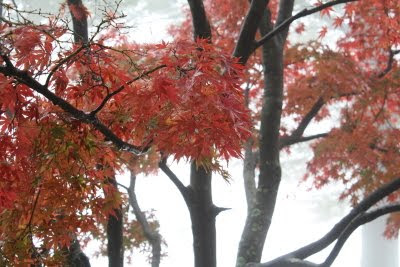 I love taking pictures of autumn leaves. :)
 Last part of the walk to the summit.
I specially like the above picture. It makes you feel that you're walking steadily towards an unknown and that at the end of the bright tunnel, something beautiful awaits you.
I was not disappointed. The interesting part was that while we were up at the summit, the scene that initially greeted us was all white. However after some time, the sky began to clear and I understood why there were so many people at the summit and I do include old folks. We almost missed it if not for the fact that I was preoccupied taking pictures of a pigeon up a tree that was looking curiously at me. :)
The scenery up there is amazing. You could see rows and rows of mountains and one of which is supposedly Mount Fuji. Unfortunately, I did not manage to catch any glimpse though because the sky was still partially cloudy. :(
Below are some of the photos that I took up the summit. If given a chance again, I believe my wife and I may just stay there and make sure that we could see everything. :) For people who likes nature, I highly recommend going up to the summit, provided you are capable of walking up the mountain. The trail can be quite muddy. :)
 A tree with pretty autumn leaves
 Autumn leaves again. :)
 Small sign saying that you have reached the summit.
Note that big white patch you see behind the board
 What you see when the sky partially cleared (no more white patch).
Beautiful scenery
 Another section of the summit
 Trees with autumn leaves surrounding the summit area
Mount Takao in Tokyo, also known as Takaosan, is quite accessible through the subway (from Shinjuku station). Upon arriving, you'll see a big sign board telling you how big the mountain is. :)
 Sign board showing the routes up Takaosan
There are 2 ways up the mountain. One is the old fashion way of walking all the way up and the other, is to use the electric train that goes halfway up the mountain and runs every 15mins. No prizes for guessing which option I took. :)
Below are some photos of the train station where you can take the train up. The train fare is quite obvious from the photos so I leave it to you to read it. :)
 Train station to go up the mountain
 Area surrounding the train station
 Interior of the train station and the train fares sign board.
Upon disembarking from the halfway point, the picture below will be the scenery that greets you. It's quick remarkable that you can find such natural scenery in Tokyo city. I like the way the clouds partially cover some areas. It makes the place mysterious. :)
 Scenery from the train station up the mountain
Do you think that's the end? Of course not. You'll still have to climb a bit to reach the summit. Unfortunately, it was raining by the time we arrived and it was a bit difficult to carry an umbrella and take photos at the same time. Oh well...
It was quite refreshing though to walk up the mountain in the rain. :) Below are some random pictures that I took while walking up the mountain.
 Some very old tree. 450 years old I think
 This was beside the tree. Not sure what it is but it looks interesting. :)
 A walkway that was lined with these boards. Couldn't really understand what was written on it.
 Something similar to the 10 commandments. How nice if everyone follows it.
 Interesting statues
 I love taking pictures of autumn leaves. :)
 Last part of the walk to the summit.
I specially like the above picture. It makes you feel that you're walking steadily towards an unknown and that at the end of the bright tunnel, something beautiful awaits you.
I was not disappointed. The interesting part was that while we were up at the summit, the scene that initially greeted us was all white. However after some time, the sky began to clear and I understood why there were so many people at the summit and I do include old folks. We almost missed it if not for the fact that I was preoccupied taking pictures of a pigeon up a tree that was looking curiously at me. :)
The scenery up there is amazing. You could see rows and rows of mountains and one of which is supposedly Mount Fuji. Unfortunately, I did not manage to catch any glimpse though because the sky was still partially cloudy. :(
Below are some of the photos that I took up the summit. If given a chance again, I believe my wife and I may just stay there and make sure that we could see everything. :) For people who likes nature, I highly recommend going up to the summit, provided you are capable of walking up the mountain. The trail can be quite muddy. :)
 A tree with pretty autumn leaves
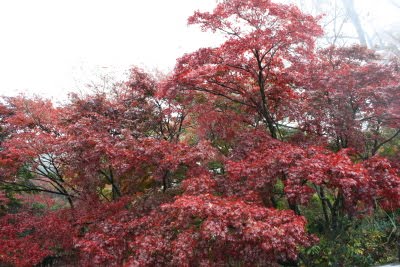 Autumn leaves again. :)
 Small sign saying that you have reached the summit.
Note that big white patch you see behind the board
 What you see when the sky partially cleared (no more white patch).
Beautiful scenery
 Another section of the summit
 Trees with autumn leaves surrounding the summit area
Friday, November 20, 2009
Random Pictures around Tokyo
Topic(s):
Travel,
Travel (Japan - Tokyo)
Updated 21 Nov 2009: Added the traditional Japanese wedding photo
 Cute photo of an owner walking the cat
 Cute photo of a cat wondering why is everyone looking at it
 Nice scenery along the way to the subway
 Design Fiesta Gallery at Harajuku
 Cute display outside a clothings store at Harajuku
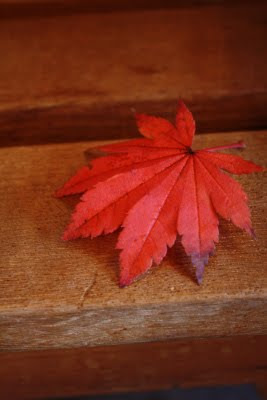 Autumn Leaf
 Pigeon high up on Takaosan
 Traditional Japanese Wedding at Meiji Shrine at Harajuku
 Cute photo of an owner walking the cat
 Cute photo of a cat wondering why is everyone looking at it
 Nice scenery along the way to the subway
 Design Fiesta Gallery at Harajuku
 Cute display outside a clothings store at Harajuku
 Autumn Leaf
 Pigeon high up on Takaosan
 Traditional Japanese Wedding at Meiji Shrine at Harajuku
Thursday, November 19, 2009
Kawaguchiko Scenery
Topic(s):
Travel,
Travel (Japan - Tokyo)
Recently came back from a short trip to Tokyo. Went up to Kawaguchiko initially with the intention to go up to the 5th station of Mt Fuji. However, it was raining that day and the temperature was already around 5 degrees celsius at Kawaguchiko. As such, the plan was abandoned and instead, we took the Retro bus around Kawaguchiko from the Kawaguchiko Station.
There are 2 kinds of fares for the Retro bus. One is the 1000 yen 2 day ticket that allows you to stop and board the bus anytime you want (unlimited travel). The other if I recall correctly is an one-time 500 yen ticket.
Below are pictures of the Kawaguchiko station and the Retro bus.
 Kawaguchiko Station
 Retro Bus at Kawaguchiko Station
It seems like when its raining, you can't really do much around Kawaguchiko which was really a pity. We ended up buying snacks around the area and taking pictures of the scenery. The autumn leaves are quite beautiful, especially so when it was still drizzling slightly when the photos were taken. Enjoy the photos.
 Interesting trains at Kawaguchiko Station
 Thomas the tank engine at Kawaguchiko Station
 Trees lining up a driveway up a resort
 Pretty autumn leaves I
 Pretty autumn leaves II
 Pretty autumn leaves surrounding the resort
 Trees lining up a driveway going into the resort
 A section of Kawaguchiko
There are 2 kinds of fares for the Retro bus. One is the 1000 yen 2 day ticket that allows you to stop and board the bus anytime you want (unlimited travel). The other if I recall correctly is an one-time 500 yen ticket.
Below are pictures of the Kawaguchiko station and the Retro bus.
 Kawaguchiko Station
 Retro Bus at Kawaguchiko Station
It seems like when its raining, you can't really do much around Kawaguchiko which was really a pity. We ended up buying snacks around the area and taking pictures of the scenery. The autumn leaves are quite beautiful, especially so when it was still drizzling slightly when the photos were taken. Enjoy the photos.
 Interesting trains at Kawaguchiko Station
 Thomas the tank engine at Kawaguchiko Station
 Trees lining up a driveway up a resort
 Pretty autumn leaves I
 Pretty autumn leaves II
 Pretty autumn leaves surrounding the resort
 Trees lining up a driveway going into the resort
 A section of Kawaguchiko
Odaiba Night Scene
Topic(s):
Travel,
Travel (Japan - Tokyo)
Recently came back from a short trip to Tokyo. Previously, the tour that I was in brought me to Odaiba in the day time. This time however, I managed to have a chance to visit Odaiba at night. I bet you cannot go there at night if you're in a tour. :)
All I can say is that the night scene at Odaiba is more for photobuffs. It was pretty cold as it is approaching winter but the night scene there is quite beautiful. Despite the cold, there are many people snapping away on their cameras. I've also spotted a few photobuffs with tripods taking pictures of the scenery. Unfortunately, I did not have a tripod or a zoom lens with me so I have to make-do with whatever I can find there.
Below are some of the more decent shots that I have. Judging that I have no tripod, I thought I did pretty well. :p
 Colorful Odaiba Ferris Wheel (Blue)
 Colorful Odaiba Ferris Wheel (Green)
 Odaiba Replica of the Statue of Liberty (zoomed-out)
 Odaiba Replica of the Statue of Liberty (zoomed-in)
 Rainbow Bridge, Tokyo Tower and Statue of Liberty
 Rainbow Bridge and Tokyo Tower (zoomed-out)
 Rainbow Bridge and Tokyo Tower (zoomed-in)
All I can say is that the night scene at Odaiba is more for photobuffs. It was pretty cold as it is approaching winter but the night scene there is quite beautiful. Despite the cold, there are many people snapping away on their cameras. I've also spotted a few photobuffs with tripods taking pictures of the scenery. Unfortunately, I did not have a tripod or a zoom lens with me so I have to make-do with whatever I can find there.
Below are some of the more decent shots that I have. Judging that I have no tripod, I thought I did pretty well. :p
 Colorful Odaiba Ferris Wheel (Blue)
 Colorful Odaiba Ferris Wheel (Green)
 Odaiba Replica of the Statue of Liberty (zoomed-out)
 Odaiba Replica of the Statue of Liberty (zoomed-in)
 Rainbow Bridge, Tokyo Tower and Statue of Liberty
 Rainbow Bridge and Tokyo Tower (zoomed-out)
 Rainbow Bridge and Tokyo Tower (zoomed-in)
Wednesday, November 18, 2009
Tokyo Food!!
Topic(s):
Travel,
Travel (Japan - Tokyo)
Recently came back from a short trip to Tokyo. As this is a DIY trip, I got a better feel of the cost of food than my previous trip to Hokkaido. You can refer to my previous post here.
Breakfast in general cost about 100 to 200 yen, excluding drinks. Got all of my breakfast from convenience stores situated around the hotel I was staying at. In general if you're an average eater, you can get your lunch and dinner for about 500 to 600 yen. However if you're looking at set meals, the averages I've given in my previous post are quite accurate. For this trip, my lunches and dinners average around 700 to 850 yen, with one exception of 1,460 yen. :)
I've taken a few photos of some of my meals. Feeling hungry? :)
 One of my lunch set that I got from shops around my hotel
 One of my lunch set that I got from Kawaguchiko station.
The rice is shaped like Mt Fuji. :)
 One of my dinner set that I got from Shinjuku.
 My ramen lunch at Takaosan. Unique part is I have to pound my own sesame. :)
 My 1,460 yen dinner. Omu rice set that comes with a salad that has already disappeared into my stomach and the green juice (melon I think)
 One of my lunch set at Ikebukuro. Do you see the egg in the middle of the bowl? :)
Breakfast in general cost about 100 to 200 yen, excluding drinks. Got all of my breakfast from convenience stores situated around the hotel I was staying at. In general if you're an average eater, you can get your lunch and dinner for about 500 to 600 yen. However if you're looking at set meals, the averages I've given in my previous post are quite accurate. For this trip, my lunches and dinners average around 700 to 850 yen, with one exception of 1,460 yen. :)
I've taken a few photos of some of my meals. Feeling hungry? :)
 One of my lunch set that I got from shops around my hotel
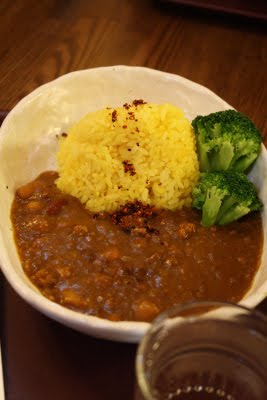 One of my lunch set that I got from Kawaguchiko station.
The rice is shaped like Mt Fuji. :)
 One of my dinner set that I got from Shinjuku.
 My ramen lunch at Takaosan. Unique part is I have to pound my own sesame. :)
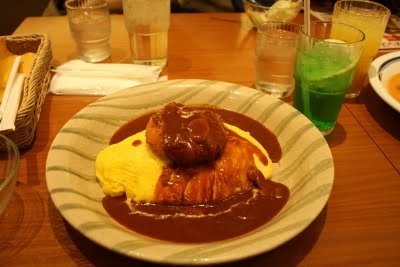 My 1,460 yen dinner. Omu rice set that comes with a salad that has already disappeared into my stomach and the green juice (melon I think)
 One of my lunch set at Ikebukuro. Do you see the egg in the middle of the bowl? :)
Subscribe to:
Posts (Atom)

