I was reading the news recently where it was reported that Changi Airport handled 4.33 million passenger movements in January 2013. That was where it hit me that the current population whitepaper didn't seem to talk about tourists coming into Singapore.
It makes sense... If you're upgrading the infrastructure to support the population, you will also need to take into account that tourists will need someway of getting around Singapore
Using the worst case assumption that all the passenger movements translates to tourists that had to move around Singapore, that will mean that almost 10 million people were in Singapore in January 2013.
Is that why we feel that we're increasingly being squeezed in our own country?
Thursday, February 28, 2013

Wednesday, February 27, 2013
Using Big Data to uncover patterns and trends
Topic(s):
Technology Ramblings
Big Data is something that is now very commonly heard of in the technology arena. What is Big Data? Simply put. It's about process large amount of information, mostly for the purpose of business intelligence. Hadoop is one of the more popular Big Data tools that organisations use.
Recently I was discussing with my wife about the the data set used for the population paper when I mentioned that Big Data technology might have been used.
It makes sense for Big Data tools to be used because we're talking about many parameters here. To some, increasing or decreasing the number of foreigners in Singapore seems a straight forward decision, but few realise the impact that it will bring to the other aspects.
The population whitepaper is skewed towards explaining the rationale of why the population needs to be increased. It talks about the different areas that will be affected if the population increases, namely housing, transport and health. All these are parameters that the big data tool can analyse and predict the impact when the population increases.
However, how about decreasing the population? With the recent backlash with the CECA agreement with India, few will remember that the decisions we make as a country may impact some of the agreements that were signed with other countries. The tools will be able to help predict such issues, that is provided the parameter and information have been added in.
Looks like Big Data is useful when you're trying to see the future when certain decisions are being made. It is able to uncover patterns and trends if the relationship between the different data sets are properly configured.
However, one note of caution. The tool is only as smart as the person using it. Do not blame the tool or technology if you do not know how to properly use it.
Recently I was discussing with my wife about the the data set used for the population paper when I mentioned that Big Data technology might have been used.
It makes sense for Big Data tools to be used because we're talking about many parameters here. To some, increasing or decreasing the number of foreigners in Singapore seems a straight forward decision, but few realise the impact that it will bring to the other aspects.
The population whitepaper is skewed towards explaining the rationale of why the population needs to be increased. It talks about the different areas that will be affected if the population increases, namely housing, transport and health. All these are parameters that the big data tool can analyse and predict the impact when the population increases.
However, how about decreasing the population? With the recent backlash with the CECA agreement with India, few will remember that the decisions we make as a country may impact some of the agreements that were signed with other countries. The tools will be able to help predict such issues, that is provided the parameter and information have been added in.
Looks like Big Data is useful when you're trying to see the future when certain decisions are being made. It is able to uncover patterns and trends if the relationship between the different data sets are properly configured.
However, one note of caution. The tool is only as smart as the person using it. Do not blame the tool or technology if you do not know how to properly use it.
Tuesday, February 26, 2013
Inflation is up 3.6%
Topic(s):
Economic Ramblings,
Singapore Ramblings
These are the Singapore inflation rates for 2013:
January: 3.6%
Transport and Housing are leading the pack, rising by 8.5% and 4.4% respectively year on year, where housing is significantly lower than December's inflation.
Inflation is down from last month due to most probably the high base from January last year. However, there shouldn't be much variation and this month's inflation should be around this month's inflation.
The budget news may help to bring down the transport and housing inflation, if the policies work as intended. Let's see.
January: 3.6%
Transport and Housing are leading the pack, rising by 8.5% and 4.4% respectively year on year, where housing is significantly lower than December's inflation.
Inflation is down from last month due to most probably the high base from January last year. However, there shouldn't be much variation and this month's inflation should be around this month's inflation.
The budget news may help to bring down the transport and housing inflation, if the policies work as intended. Let's see.
Direct Benefits for Households in Budget 2013
Topic(s):
Singapore Ramblings
I am only highlighting some of the more direct benefits (non-business
related) to households. Looking at the benefits to businesses, it's more of the same message as last year, where you can
see the general direction is that
businesses should evolve to make use of the skills of the locals. On the
other hand, they are also providing productivity packages to the
companies in order to encourage them to train their workers. In addition, they are further restricting the inflow of foreign workers, especially in those areas where productivity is the lowest.
The benefits in this budget again does nothing in enhancing work-life balance for all Singaporeans. All the benefits are mostly in monetary terms. There is still no definition of how the productivity is to be measured. Labour Productivity (average output per worker-hour) should be emphasized instead of general productivity. As you can see from year 2012, productivity went down compared to previous years, which coincidentally happened when foreign workers inflow have been restricted. Maybe there should be more transparency in how labour productivity is being measured.
Anyway, below are some of the more direct benefits to households:
For more information on the budget 2013, you can visit the budget website here.
The benefits in this budget again does nothing in enhancing work-life balance for all Singaporeans. All the benefits are mostly in monetary terms. There is still no definition of how the productivity is to be measured. Labour Productivity (average output per worker-hour) should be emphasized instead of general productivity. As you can see from year 2012, productivity went down compared to previous years, which coincidentally happened when foreign workers inflow have been restricted. Maybe there should be more transparency in how labour productivity is being measured.
Anyway, below are some of the more direct benefits to households:
- Changes to Workfare Income Supplement (WIS) will see more employees eligible as the eligibility limit has been upped to $1,900 per month, from $1,700 per month.
- Maximum WIS payouts for employees will be increased by up to $700 with more going to older workers aged 45 years and above, where the increase will be capped to 25% - 50% of the maximum payout.
- Employees will now receive 40% of WIS in cash, upped from 29%, and more CPF payouts will be channeled into the CPF Medisave and Special accounts.
- To quality for WIS, the individual and spouse, in addition, must not own 2 or more properties, and the annual assessable income of the spouse does not exceed $70,000.
- CPF contribution rates will be increased for low-wage workers as shown in the table below.

- From 1 January 2014, the revised property tax rates for owner occupied residential properties will be as shown in the table below.

- From 1 January 2014, vacant properties will no longer enjoy property tax refunds.
- From 1 January 2014, the revised property tax rates for non owner occupied residential properties, including let-out or vacant properties, will be as shown in the table below.

- GST vouchers will be doubled for lower and middle income households for 2013, as shown in the tables below.

- Service & Conservancy charges rebates will be given for the year 2013, as shown in the table below.

- $200 medisave top-up will be given to Singaporeans aged 45 years and above in 2013.
- Resident-individual taxpayers below 60 years old as at 31 December 2012 will be granted a 30% rebate, capped at $1,500 per taxpayer, for Year of Assessment 2013.
- Resident-individual taxpayers aged 60 years and above as at 31 December 2012 will be granted a 50% rebate, capped at $1,500 per taxpayer, for Year of Assessment 2013.
- From 1 March 2013, the concessionary (looking after Singaporean dependents, namely young children, elderly and family members with disabilities) Foreign Domestic Worker (FDW) levy will be reduced to $120/month, down from the current $170 per month. The non-concessionary FDW levy is $265/month.


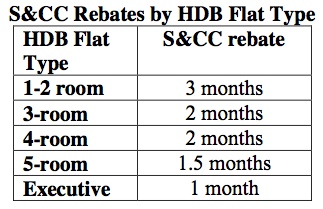
For more information on the budget 2013, you can visit the budget website here.
Monday, February 25, 2013
What is India complaining about the CECA?
Topic(s):
Singapore Ramblings
Since there was so much talk on the CECA agreement signed with India in 2005, I took a look at the FTA agreement. I do not really know what is India complaining about.
It's clearly stated in Chapter 9 of the agreement, article 9.8, that nothing in the chapter shall prevent a party from applying measures to regulate the entry of natural persons of the other Party into, or their temporary stay in, its territory, including those measures necessary to protect the integrity of, and to ensure the orderly movement of natural persons across its borders, provided that such measures are not applied in such a manner as to nullify or impair the benefits accruing to the other Party under the terms of this Chapter.
Translated, as long as Singapore is not preventing foreigners from entering the country, Singapore is definitely allowed to regulate the number of foreigners entering the country. If Singapore stop all foreigners, or specific foreigners, from coming into the country for work, then India may have a case.
At least that's how I read the Chapter.
It's clearly stated in Chapter 9 of the agreement, article 9.8, that nothing in the chapter shall prevent a party from applying measures to regulate the entry of natural persons of the other Party into, or their temporary stay in, its territory, including those measures necessary to protect the integrity of, and to ensure the orderly movement of natural persons across its borders, provided that such measures are not applied in such a manner as to nullify or impair the benefits accruing to the other Party under the terms of this Chapter.
Translated, as long as Singapore is not preventing foreigners from entering the country, Singapore is definitely allowed to regulate the number of foreigners entering the country. If Singapore stop all foreigners, or specific foreigners, from coming into the country for work, then India may have a case.
At least that's how I read the Chapter.
Friday, February 22, 2013
Do not work in your own little world
Topic(s):
Self Improvement
I quote from Marilyn vos Savant:
Simply put. Virtual communication can never replace live communication.
Email, instant messaging, and cell phones give us fabulous communication ability, but because we live and work in our own little worlds, that communication is totally disorganized.
Simply put. Virtual communication can never replace live communication.

Wednesday, February 20, 2013
Problems with the new global economy
Topic(s):
Thoughts
Looking at the new global economy, I believe the developed countries have come to a point where there must be a choice between GDP growth, or happiness growth.
The reason is quite simple. The problem with growth of GDP is that it assumes that demand will always be greater than supply. That's why some liken it to ponzi growth. Some countries create demand by either having more citizens, or getting more immigrants, or having both. Purpose? To create demand.
Are there other ways to boost salary and create jobs? You may be able to boost salary by improving productivity, but it is difficult to create jobs just purely by improving productivity. Harley Davidson is now producing 41 bikes per worker per year, compared to a decade before (33 bikes per worker). What does that indicate? Salary increment? Maybe. Lesser workers, definitely.
What I know that could create jobs is innovation. Creating something out of nothing. That will create new jobs and sometimes, even new industries. However, there is a catch. Do you think you have time for innovation if you spend your time working your butts off at your current job? Not likely. Innovations actually could also help to increase salary, but it's harder to achieve though.
Chicken and egg problem. A salary increment comes with increased productivity, which not surprisingly enough usually comes with more work. If you spend your time working, innovation is difficult because you spend your time meeting deadlines after deadlines, or fighting "fires" all the time.
It's a vicious cycle if you're trying to have both. But... What if you're only concentrating on innovation?
The reason is quite simple. The problem with growth of GDP is that it assumes that demand will always be greater than supply. That's why some liken it to ponzi growth. Some countries create demand by either having more citizens, or getting more immigrants, or having both. Purpose? To create demand.
Are there other ways to boost salary and create jobs? You may be able to boost salary by improving productivity, but it is difficult to create jobs just purely by improving productivity. Harley Davidson is now producing 41 bikes per worker per year, compared to a decade before (33 bikes per worker). What does that indicate? Salary increment? Maybe. Lesser workers, definitely.
What I know that could create jobs is innovation. Creating something out of nothing. That will create new jobs and sometimes, even new industries. However, there is a catch. Do you think you have time for innovation if you spend your time working your butts off at your current job? Not likely. Innovations actually could also help to increase salary, but it's harder to achieve though.
Chicken and egg problem. A salary increment comes with increased productivity, which not surprisingly enough usually comes with more work. If you spend your time working, innovation is difficult because you spend your time meeting deadlines after deadlines, or fighting "fires" all the time.
It's a vicious cycle if you're trying to have both. But... What if you're only concentrating on innovation?
Tuesday, February 19, 2013
Time for carbon tax
Topic(s):
Thoughts
It's time for the world to really consider carbon tax. A study has indicated that the West Antarctic Ice Sheet, whose melt may be responsible for 10 percent of the sea-level rise caused by climate change, is warming twice as quickly as previously thought.
A re-analysis of temperature records from 1958 to 2010 revealed an increase of 2.4 deg C over the period - three times the average global rise.
What has that to do with carbon tax? The problem with the world now is that everyone wants to do it cheaper, better, and faster. So what happens? Increase productivity? Not very likely. Instead, businesses usually look at their bottom line and most probably, quality drops and shortcuts are taken.
So what happens when shortcuts are taken? More pollutants are inevitably been released more because the fact is that many are going the way of cheap energy. Cheap energy is easy to find and cheap to use.
How do you then discourage businesses from using energy that releases more pollutants? The only way is to make those types of energy more expensive. How do you do that?
Carbon tax is one way. Tax the carbon that is being released out into the air and use the money to invest in clean energy.
There are obviously people who said that this is a load of bull. Well, to these people, I ask them to stay at Beijing for a few years and breathe in their smog, and then tell me after that if it is a load of bull.
What has that to do with carbon tax? The problem with the world now is that everyone wants to do it cheaper, better, and faster. So what happens? Increase productivity? Not very likely. Instead, businesses usually look at their bottom line and most probably, quality drops and shortcuts are taken.
So what happens when shortcuts are taken? More pollutants are inevitably been released more because the fact is that many are going the way of cheap energy. Cheap energy is easy to find and cheap to use.
How do you then discourage businesses from using energy that releases more pollutants? The only way is to make those types of energy more expensive. How do you do that?
Carbon tax is one way. Tax the carbon that is being released out into the air and use the money to invest in clean energy.
There are obviously people who said that this is a load of bull. Well, to these people, I ask them to stay at Beijing for a few years and breathe in their smog, and then tell me after that if it is a load of bull.
Monday, February 18, 2013
Annuity is also about viability of the company
Topic(s):
Retirement Planning
I was recently reading about annuities and it struck me that most seem to be more intent in looking at the yields of the plan, but few seem to be focusing on the sustainability of the plan.
What is the objective of annuity plans? Simple. It's about hedging the risks that you will live longer than expected. Therefore, I'm surprised that people are not looking at the sustainability of the company offering the annuity plans.
This should be first and foremost the first thing in your mind. Is the annuity plan sustainable? Is the annuity model able to withstand the test of time? Will the company still be around when I'm old?
Whatever product that you purchase, you should not forget the objective of purchasing it. What is the intent. What is it hedging against. Yield is important, but it's not everything. It's no use going for a product that gives you 8% yield, but unsustainable.
What is the objective of annuity plans? Simple. It's about hedging the risks that you will live longer than expected. Therefore, I'm surprised that people are not looking at the sustainability of the company offering the annuity plans.
This should be first and foremost the first thing in your mind. Is the annuity plan sustainable? Is the annuity model able to withstand the test of time? Will the company still be around when I'm old?
Whatever product that you purchase, you should not forget the objective of purchasing it. What is the intent. What is it hedging against. Yield is important, but it's not everything. It's no use going for a product that gives you 8% yield, but unsustainable.
Friday, February 15, 2013
To give is to love, to withhold is to wither
Topic(s):
Self Improvement
I quote from Kent Nerburn:
Remember to be gentle with yourself and others. We are all children of chance and none can say why some fields will blossom while others lay brown beneath the August sun. Care for those around you. Look past your differences. Their dreams are no less than yours, their choices no more easily made. And give, give in any way you can, of whatever you posses. To give is to love. To withhold is to wither. Care less for your harvest than for how it is shared and your life will have meaning and your heart will have peace.
Subscribe to:
Posts (Atom)

